


Media
Photos, Videos & Behind-the-Scenes Material
The Photo Gallery
Selected stills, fieldwork images, and visual materials from the film’s production in Bulgaria and the Uited States.

Dr. Shea, Curator of Seals and Coins at Dumbarton Oaks, is the scholar responsible for the preservation of Tervel’s seal - one of the most valuable artifacts from Bulgaria’s early medieval past.

An image of St. King Trivelius (Tervel) from a Bulgarian Revival-era church. According to tradition, the ruler ended his life as a monk under the name Theoktistos.

Prof. Zhekova is one of the foremost experts on medieval seals and among the few scholars who have worked directly with Tervel’s seal.

Drones, LiDAR, and laser scanning are transforming archaeology. New technologies reveal structures and traces invisible from the ground.

Experts believe this is an authentic portrait of the ruler. It is the oldest preserved portrait of a Bulgarian ruler - and of a Bulgarian person in general. © Dumbarton Oaks, Coins and Seals Collection, Washington, DC.

Bulgaria’s first capital, Pliska, covered an enormous territory. Although excavations have been ongoing for over a century, archaeologists have uncovered less than one percent of the ancient city.

Using a portable laser scanner, Plamen Petkov created an exact 3D copy of the seal. Even if the original were ever damaged, its precise digital twin will remain preserved for science.

A donation charter of Tsar Ivan Alexander from 1347. It is assumed that Tervel’s seal was similarly attached to an important document sent to the Byzantine emperor.

Behind this armored museum door are artifacts that may be directly connected to the era of Tervel and the early Bulgarian royal tradition.
Behind the Scenes
The Seal of Tervel combines fieldwork, archeological excavations, archival research, academic interviews, ancient DNA analysis, and high-resolution scanning of rare medieval artifacts. Our production uses advanced tools - including drones, 3D imaging, and specialized scientific equipment to document sites and materials wit unprecedented precision.
Filming takes place across Bulgaria, Turkey, the United States, and Switzerland, including Pliska, Madara, Shumen, Vidin, Sofia, Istanbul, Basel, Washington, D.C., Cambridge, and other key locations
connected to the story.

The aerial perspective reveals patterns and connections invisible to observers on the ground.

Excavations in Pliska, 2025 season.

Results are forthcoming from a large-scale DNA study of hundreds of samples from necropolises of the First Bulgarian Empire - a project that may offer a definitive answer about the origins of the Bulgarian people.

The reverse side of the seal bears a prayer monogram reading: “Mother of God, lend Thy aid. Tervel, kaisar.” © Dumbarton Oaks, Coins and Seals Collection, Washington, DC.
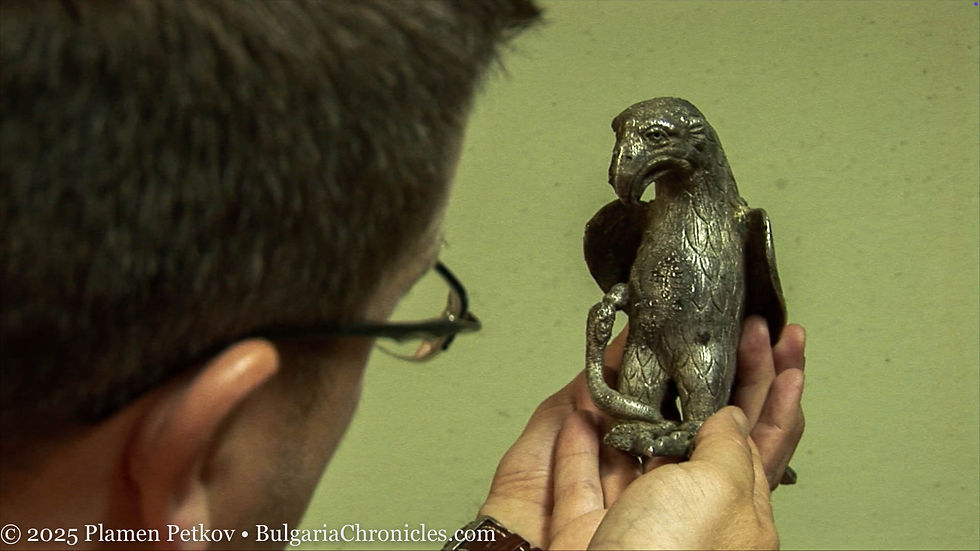
Khan Asparuh founded Danubian Bulgaria. His direct successor was Tervel (700–721). The silver eagle is kept in a secure vault in Zaporizhzhia, close to the active conflict zone.


A discovery made by Prof. Rashev decades ago gains new and even greater significance today.

This unique ancient relief is carved into a cliff near Shumen. Beneath the horse, words from an inscription ordered by Tervel 1,300 years ago can still be discerned.

A panoramic view from the plateau of the Madara Horseman. At the foot of the rock lies the village of Madara.